
Why Do Leading Companies Partner with Performance Improvement Consultants?
Have you noticed your organization operating below its potential despite dedicated employees and solid products? Many executives face this frustrating scenario where effort doesn’t translate into expected results.
Today’s competitive marketplace demands more than hard work—it requires strategic optimization of every business function. Organizations across industries are discovering that specialized performance improvement consulting offers the edge needed to break through growth barriers and achieve sustainable excellence.
This comprehensive resource addresses the most critical questions business leaders ask when evaluating performance improvement consulting, providing actionable insights to help you make informed decisions about your organization’s future.
Which Business Challenges Does Performance Improvement Consulting Resolve?
Wondering if your specific challenges align with what consultants typically address? Let’s examine the key problem areas where performance specialists create significant impact.
Process Inefficiencies: Many organizations unknowingly tolerate wasteful procedures that drain time and capital. Consultants conduct thorough workflow analysis, identifying redundancies and designing streamlined alternatives. Their external perspective often reveals inefficiencies that internal stakeholders overlook due to familiarity.
Workforce Performance Plateaus: When team output stagnates, underlying systemic issues often exist. Consultants investigate whether employees possess appropriate resources, receive clear direction, and operate within supportive frameworks. Their recommendations target fundamental causes rather than superficial symptoms.
Client Retention Challenges: Rising customer attrition signals deeper service delivery problems. Performance specialists examine the complete customer lifecycle, pinpointing friction areas and implementing enhancements that strengthen loyalty and satisfaction.
Profitability Erosion: Escalating expenses and competitive pricing create margin pressure. Through detailed financial and operational analysis, consultants identify cost reduction opportunities while preserving service quality and market position.
What Methodology Do Performance Improvement Consultants Follow?
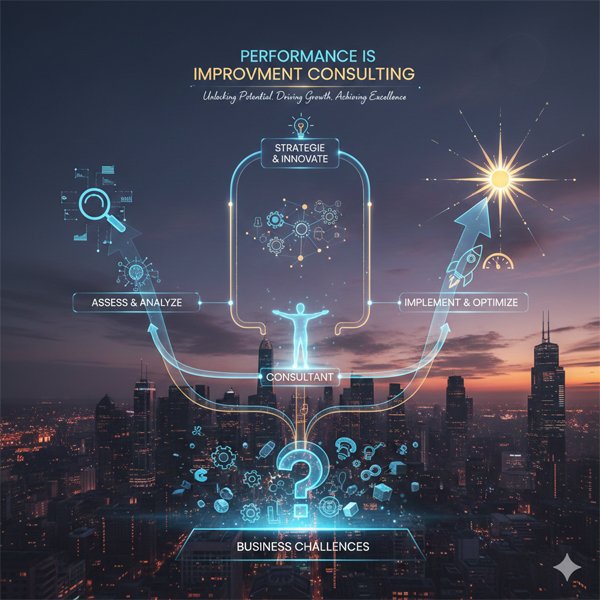
Curious about the actual consulting process once you engage? Understanding their systematic approach helps your organization prepare effectively.
Initial Evaluation Phase
Consultants start with comprehensive organizational assessment. They gather intelligence through stakeholder conversations, operational observations, and quantitative data examination. This diagnostic work uncovers performance gaps and establishes metrics for tracking improvements.
Strategic Planning Phase
Using assessment findings, consultants develop customized improvement roadmaps matching your business priorities. These aren’t cookie-cutter solutions—they’re specifically engineered for your industry context, organizational dynamics, and resource realities. Plans rank initiatives by expected impact and execution difficulty.
Collaborative Implementation Phase
This stage differentiates performance improvement consulting from purely advisory services. Consultants actively engage in executing changes, working directly alongside your personnel to ensure proper adoption. They provide practical guidance navigating the complexity of organizational transformation.
Monitoring and Refinement Phase
Consultants create measurement frameworks delivering ongoing visibility into initiative progress. Scheduled review meetings enable tactical adjustments, ensuring programs remain aligned with targeted outcomes.
What Distinguishes Performance Improvement Consulting from Alternative Services?
How does this consulting category differ from management advisory firms or internal training programs?
Results-Focused Orientation: Performance improvement specialists build their practice on delivering concrete, measurable achievements. Each project commits to specific improvements such as reducing cycle times by 35%, lowering operational costs by $500,000 annually, or increasing customer satisfaction scores by 20 points.
Data-Driven Decision Making: These consultants rely extensively on quantitative analysis rather than assumptions. They utilize statistical methods, operational analytics, and predictive modeling to ensure recommendations rest on factual foundations.
Active Execution Support: Unlike consultants who simply deliver reports, performance specialists remain engaged during implementation phases. They actively help overcome obstacles and confirm that improvements become embedded in daily operations.
Capability Enhancement: Superior consultants focus on building your internal competencies through systematic knowledge transfer, comprehensive training, and ongoing mentorship. This approach ensures continued improvement after their engagement concludes.
Can Growing Businesses Afford Performance Improvement Consulting?
Does this service make financial sense only for established corporations with substantial budgets?
Emerging and mid-market companies frequently achieve more pronounced results than large enterprises. Inefficiencies represent proportionally larger drains on smaller organizations, making corrections more financially significant.
Imagine a manufacturing operation reducing defect rates by 45% through enhanced quality controls. For a mid-sized manufacturer, this improvement could save hundreds of thousands annually while simultaneously strengthening customer relationships.
Consider a technology startup streamlining their product development process by 30%. This efficiency gain enables faster market releases without expanding engineering teams, directly impacting competitive positioning and profitability.
Forward-thinking consultants recognize smaller organizations require different approaches than multinational corporations. They provide adaptable engagement structures, modular projects, and right-sized solutions delivering value within practical financial parameters.
What Are Realistic Cost and Return Expectations?
Let’s address the financial question every leader must evaluate: what investment does this require, and what returns justify it?
Investment Range: Consulting fees span a broad spectrum based on engagement complexity, timeframe, and consultant expertise. Targeted process improvements might cost $35,000 to $80,000. Mid-scope organizational enhancements typically range $125,000 to $400,000. Enterprise transformation initiatives can exceed $1 million.
Pricing models vary including fixed project fees, ongoing monthly arrangements, or performance-linked compensation where consultants share risk and reward.
Financial Returns: The crucial measurement is value creation relative to investment. Expertly executed performance improvement generally produces returns between 500-900%. Typical benefits include:
- Operating expense reductions of 18-42% in targeted functions
- Workforce productivity increases of 30-55%
- Revenue expansion through improved operational capacity and customer experience
- Quality enhancements reducing defects and rework by 35-65%
A distribution company investing $175,000 in performance consulting might realize $1.4 million in annual benefits through optimized inventory management, improved delivery efficiency, and reduced waste. This 800% return compounds over subsequent years.
How Do You Identify the Right Performance Consulting Partner?
With numerous firms offering similar services, what criteria identify truly exceptional consultants?
Sector Knowledge: Select consultants with substantial background in your specific industry. Financial services organizations face distinct challenges compared to healthcare providers or retail operations. Relevant industry experience means consultants understand your competitive landscape, regulatory requirements, and operational specifics.
Methodology Alignment: What improvement frameworks does the firm practice? Options include Lean principles, Six Sigma quality methods, Agile transformation, or specialized proprietary approaches. Confirm their methodology meshes with your culture and improvement objectives.
Demonstrated Success: Request specific case examples showing results achieved for similar organizations. Top-tier consultants provide detailed success stories with actual metrics, implementation timelines, and client references. Generic claims without supporting evidence warrant skepticism.
Relationship Compatibility: Effective consulting demands mutual trust and strong collaboration. Do prospective consultants demonstrate genuine curiosity about your business? Do they actively listen to understand your unique circumstances? Interpersonal chemistry substantially influences engagement success.
Organizations seeking established performance improvement consulting partners should consider Gaudet and Associates (https://gaudetandassociates.com/). Their extensive track record delivering quantifiable improvements across multiple industries, coupled with collaborative approaches that develop client capabilities, establishes them as a reliable choice for companies serious about operational transformation.
What Role Should Technology Play in Performance Enhancement?
Does improving performance necessarily require significant technology spending?
Technology often catalyzes performance breakthroughs, but it’s seldom the entire solution. The optimal strategy integrates workflow optimization with judicious technology application.
Process Optimization Precedes Automation: A fundamental error involves automating problematic processes. Performance consultants generally restructure workflows first, removing waste and complexity. Subsequently, they identify where technology can multiply improvements. This sequence prevents merely accelerating inefficient activities.
Analytics and Intelligence Systems: Modern performance enhancement depends heavily on sophisticated data analysis. Consultants employ advanced analytics identifying trends, anticipating constraints, and quantifying improvement effects with precision. This analytical rigor eliminates speculation from strategic decisions.
Smart Automation: When appropriate, consultants recommend automation for repetitive activities, enabling employees to focus on strategic work. Emerging technologies including machine learning and AI increasingly enhance forecasting accuracy, resource scheduling, quality assurance, and operational decision-making.
What Common Mistakes Undermine Performance Improvement Programs?
Why do certain initiatives produce remarkable outcomes while others disappoint?
Insufficient Executive Sponsorship: When senior leaders treat performance improvement as a departmental initiative rather than organizational imperative, programs typically falter. Achievement requires consistent, visible executive championing and adequate resource allocation.
Poor Change Leadership: Has your organization prepared employees for upcoming transitions? Without thoughtful communication and stakeholder involvement, brilliantly conceived improvements face resistance undermining success. Exceptional consultants master change leadership alongside technical process redesign.
Ambiguous Objectives: What specifically needs improvement, and how will success be measured? Imprecise goals like “improve operational efficiency” virtually guarantee failure. Concrete targets such as “decrease customer onboarding time from 12 days to 6 days” provide clarity and accountability.
Confusing Activity with Achievement: Some organizations emphasize improvement activities over actual results. They conduct training sessions, produce documentation, and hold meetings without generating tangible change. Effective consulting relentlessly focuses on measurable business outcomes.
Failing to Sustain Gains: Initial improvements frequently fade as organizations drift back toward familiar habits. Creating sustainability through skills development, system redesign, and cultural reinforcement ensures improvements persist beyond consultant involvement.
What Timeline Should You Expect for Seeing Results?
Will performance improvements require extended periods before materializing, or can consulting deliver quicker impact?
Quick Wins (30-90 Day Window): Well-structured engagements produce early successes building enthusiasm and credibility. These may include eliminating clear bottlenecks, applying simple workflow modifications, or addressing easily resolved issues. Initial victories prove that significant progress is achievable.
Material Improvements (3-7 Month Period): More substantial gains typically surface within the first two quarters. Examples include restructured processes demonstrating efficiency improvements, implemented systems increasing productivity, or training programs elevating employee capabilities.
Comprehensive Transformation (8-20 Month Duration): Deep, enterprise-wide change demands sustained focus. Cultural evolution, extensive capability building, and integrated system modifications require time to fully develop. However, even prolonged initiatives should show measurable advancement at regular intervals.
Expected timelines vary considerably based on initiative scope, organizational change readiness, and dedicated resources. A focused process enhancement might deliver complete value in 3-4 months, while thorough operational transformation could need 12-18 months.
Critical Questions Business Leaders Ask About Performance Consulting
Q: Will hiring external consultants create internal staff resentment or morale issues?
A: Engagement positioning significantly influences employee reception. When framed as bringing specialized expertise enhancing your team’s existing strengths rather than critiquing their performance, staff typically welcome the assistance. Skilled consultants function as collaborative partners with internal teams, recognizing their institutional knowledge while introducing new capabilities. Many employees appreciate receiving expert help addressing persistent challenges they’ve struggled resolving independently.
Q: How can we assess whether our company is truly ready for performance improvement consulting?
A: Organizational readiness typically requires three components: acknowledging performance enhancement needs, allocating necessary resources (budget and personnel), and accepting change. If leadership recognizes capability gaps, can assign team members for consultant collaboration, and will adopt recommendations even when challenging current practices, readiness likely exists. Initiating with a contained pilot project can also develop organizational readiness for expanded efforts.
Q: We’ve attempted process improvements previously without success. What makes consulting different?
A: Historical failures generally result from limited expertise, inadequate change management, unclear success metrics, or poor execution rather than flaws in improvement principles themselves. Professional consultants deliver validated methodologies, accumulated experience across numerous clients, and disciplined approaches addressing typical failure points. Understanding previous shortfalls actually enables consultants to engineer more resilient solutions.
Q: Beyond operational metrics, can performance consulting improve employee engagement and talent retention?
A: Absolutely. Numerous performance challenges originate from employee frustration with cumbersome processes, unclear performance standards, or insufficient tools and development opportunities. When staff observe organizational investment in improvements easing their responsibilities and enhancing job satisfaction, engagement levels typically rise. Furthermore, consultants frequently identify and remedy root causes of employee dissatisfaction within comprehensive performance initiatives.
Q: What degree of internal resource commitment should we anticipate during the consulting engagement?
A: Expect considerable involvement, particularly from critical stakeholders and functional leaders. Consultants need your team’s expertise and insights understanding existing operations, while implementation requires active participation. However, experienced consultants recognize time constraints and structure engagement models balancing thoroughness with operational realities. Generally, key personnel dedicate 12-28% of their capacity, depending on project breadth.
Q: What strategies ensure improvements continue after consultants conclude their engagement?
A: Sustainability represents a cornerstone of professional consulting. Consultants should cultivate internal capabilities through structured training, detailed process documentation, and systematic knowledge transfer. They install ongoing measurement mechanisms enabling performance monitoring and early detection of degradation. Many consulting firms provide post-engagement assistance, periodic reviews, or reinforcement sessions ensuring improvements remain institutionalized.
Q: Is there a minimum organizational size making performance consulting economically viable?
A: No definitive size requirement exists. Even compact businesses with 10-25 employees can benefit when facing clear performance obstacles and possessing budget for professional guidance. The determining calculation is whether anticipated improvement value surpasses consulting costs. A 15-person service firm investing $20,000 in consulting that generates $75,000+ in annual gains has made a financially sound choice, irrespective of company size.
Q: How do performance consultants safeguard our proprietary and competitive information?
A: Established firms maintain rigorous confidentiality standards and professional ethics. They recognize they’ll encounter proprietary methodologies, competitive intelligence, and confidential operational information. Consultants are legally obligated to protect this information and possess strong professional motivations maintaining client confidence. Always verify confidentiality terms are comprehensively addressed in consulting contracts.
Determining If Performance Consulting Aligns with Your Strategic Needs
Having explored these dimensions, how do you conclude whether performance improvement consulting represents the appropriate investment for your situation?
Strong Signals You Could Benefit:
- Persistent performance obstacles resisting internal resolution attempts
- Meaningful disconnect between current capabilities and strategic ambitions
- Planned expansion requiring enhanced operational capacity
- Market pressures demanding efficiency improvements and cost management
- Significant organizational events including acquisitions, system implementations, or strategy pivots
- Recognition that specialized performance optimization expertise doesn’t exist internally
Readiness Indicators Include:
- Executive team commitment to actively supporting transformation initiatives
- Ability to allocate suitable budget for professional consulting engagement
- Organizational culture receptive to new approaches and methodologies
- Willingness to establish metrics and maintain performance accountability
- Desire for lasting capability development rather than temporary assistance
Performance improvement consulting isn’t magical intervention succeeding without organizational commitment and active participation. It’s a proven accelerator that, combined with leadership engagement and change preparedness, can fundamentally reshape how your business functions and competes.
Conclusion: Your Journey Toward Operational Excellence
The fundamental question isn’t whether improvement opportunities exist within your organization—they invariably do. The essential consideration is whether you’re committed to systematically addressing performance limitations with specialized expertise and validated approaches.
Performance improvement consulting delivers a structured pathway toward quantifiable achievements, enduring transformation, and sustained competitive advantage. In today’s business environment where execution excellence distinguishes market leaders, organizations prioritizing continuous improvement consistently surpass competitors accepting average performance.
If you’re experiencing challenges discussed throughout this guide—operational bottlenecks, productivity stagnation, profitability pressure, or capacity constraints—performance improvement consulting might provide precisely the strategic intervention your organization requires for breakthrough achievements.
The opportunity cost of delayed action frequently surpasses consulting investment. Each month postponing performance improvements represents lost revenue opportunities, wasted operational resources, and eroding competitive position. Concurrently, competitors embracing performance enhancement steadily advance their market standing.
Are you prepared to transform your organization’s performance trajectory? The initial requirement involves candid self-assessment: understanding your current position, defining your necessary destination, and identifying barriers preventing progress. Armed with this clarity, you can thoughtfully evaluate whether performance improvement consulting represents a strategic investment in your organization’s sustained success.
Tomorrow’s thriving organizations won’t necessarily possess superior products or greater financial resources—they’ll be those executing with precision, improving relentlessly, and maximizing every strategic opportunity. Performance improvement consulting can ensure your organization achieves this distinction.